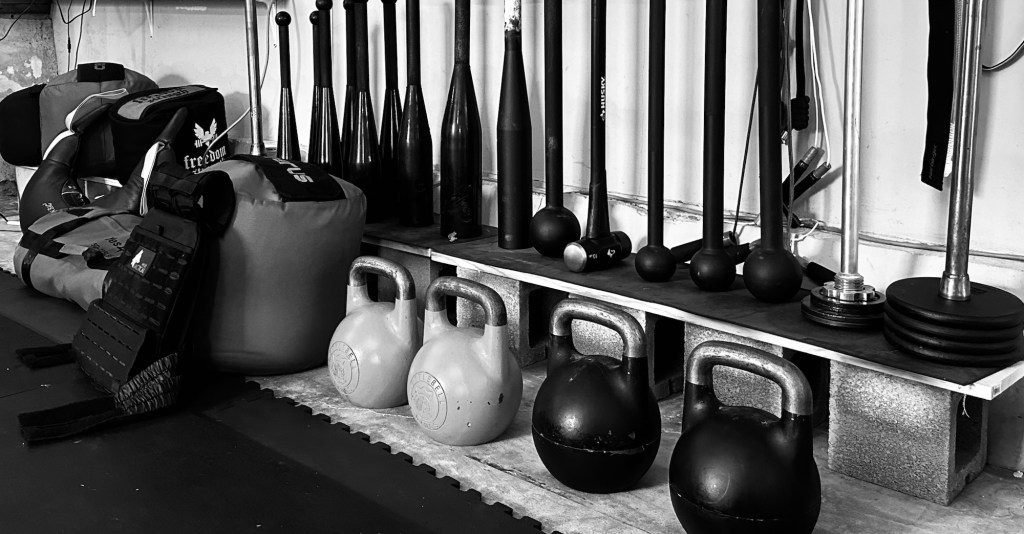
After many years of training in commercial gyms, I decided to cancel my gym membership and start training primarily at home. Life was getting busier and more complicated, and the idea of eliminating the commute and never waiting in line for a squat rack again had its appeal.
I had always dreamed of building a home gym. In these dreams, the gym had a power rack and platform as its centerpiece. I had been following barbell-centric programs for the majority of my weight training experience, and it was hard to imagine training without them. At the time, however, I was living in a small apartment, and installing a power rack was out of the question. I had a few kettlebells, a sandbag, a steel club, a weight vest and no choice but to figure out how to build strength with these more reasonably sized objects. To some, this might not seem like much of a change. You used to go to one place and lift weights, now you lift different weights at home. Just lift them and let the gains roll in. If only it were that simple.
The barbell – which my gym now lacked – is arguably the most effective strength training tool there is. While there are numerous reasons for the barbell’s effectiveness, one distinct superpower it has is the ability to adjust the weight with precision and efficiency. A barbell can transform from a 135 lb warm up into a 350lb 1RM in a matter of minutes. With this capability, training programs can prescribe precise weights to use, and these weights can be adjusted in small degrees from one set (or day) to the next.
In comparison, unconventional training tools (like kettlebells or sandbags) often come in fixed weights. The standard jump in kettlebell weights is 4-8KG per bell (~9-18lbs), and sandbags come in increments of 25-50lbs. While adjustable kettlebells have made leaps in quality in recent years, they still require a set of tools to adjust and take more time to change than a barbell.
In addition to canceling my gym membership, I would need to utilize new programs and methodology to train with these unconventional tools. I began reading as many resources as I could get my hands on and experimenting with a variety of existing programs. There are many good options available, but none quite filled the void I had. I wanted to use a blend of unconventional tools to get strong, and I planned to do this for at least the next several years. So I set about developing a framework to use to pursue these goals.
The Life After Barbells training manual is the result of my exploration, trials and errors. I hope that by formally writing it out, others can benefit from it and help improve it. If you try it out, I would love to hear about your experiences. If you have any questions, feel free to reach out directly. I am active on Reddit and Instagram and intend to continue sharing my learnings here and on Substack.
 Life After Barbells